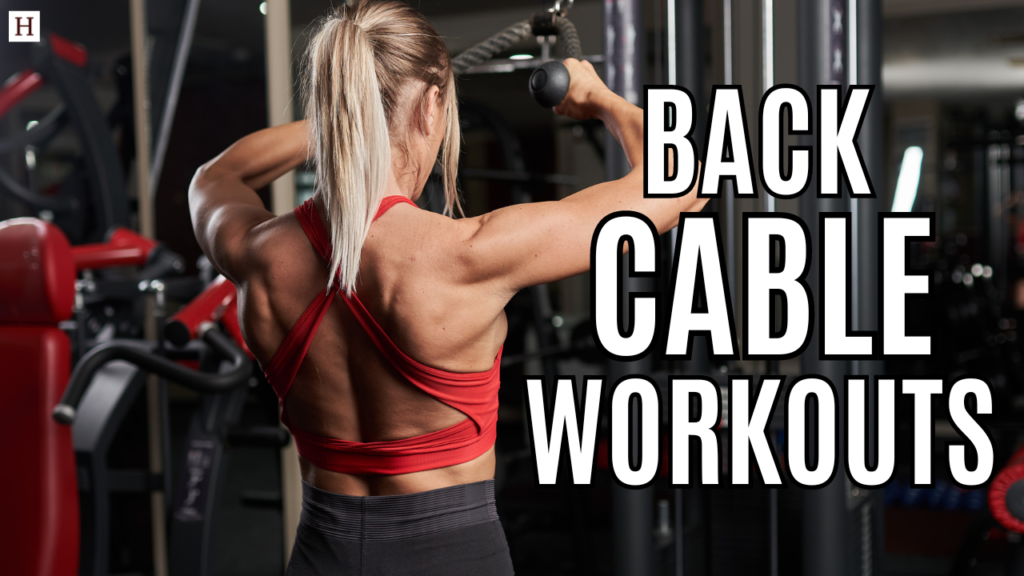
Cable exercises are some of the best ways to build your back. They keep tension on your lats and upper back throughout each rep and are easier on your lower back than many barbell lifts. Here are the 10 best back cable workouts and a routine to put them together.
Quick answer: The best back cable workouts are lat pulldowns, seated cable rows, single-arm cable rows, straight-arm pulldowns and face pulls. Do 4 to 5 exercises, for 3 sets of 8 to 15 reps, once or twice a week.
10 Best Back Cable Workouts
1. Wide-Grip Lat Pulldown
Builds back width.
- Grip the bar a little wider than shoulder width with palms facing away.
- Lean back slightly and pull the bar to your upper chest, driving your elbows down.
- Return slowly to straight arms.
2. Seated Cable Row
Builds thickness in the middle back.
- Sit with feet on the platform, knees slightly bent, holding a V-handle.
- Pull the handle to your stomach and squeeze your shoulder blades together.
- Return slowly without rounding your back.
3. Single-Arm Cable Row
Lets each side work separately with a long range of motion.
- Set a pulley at chest height and hold the handle in one hand.
- Row it towards your hip, letting your shoulder blade move back.
- Return slowly with a stretch, then switch sides.
4. Lying Cable Pullover
Isolates the lats.
- Lie on a bench with your head towards a low pulley, holding a rope or bar above your face.
- With slightly bent elbows, pull it over your head towards your hips.
- Return slowly.
5. Straight-Arm Pulldown
Teaches you to use your lats and is a great finisher.
- Stand facing a high pulley holding a straight bar or rope.
- Hinge slightly forward and keep your arms almost straight.
- Pull the bar down to your thighs in an arc, then return slowly.
6. Cable Reverse Fly
Works the rear shoulders and upper back.
- Set both pulleys at shoulder height and cross the cables, holding the left cable in your right hand and vice versa.
- Pull your arms out wide to your sides with slightly bent elbows.
- Return slowly.
7. Close-Grip Lat Pulldown
A V-handle puts more emphasis on the lower lats.
- Hold a V-handle on the pulldown machine.
- Pull it to your upper chest, keeping your elbows close.
- Return slowly.
8. Cable T-Bar Row
A cable version of the T-bar row.
- Attach a V-handle to a low pulley and step back.
- Hinge forward with a flat back and row the handle to your stomach.
- Return slowly.
9. Single-Arm Bent-Over Cable Row
Targets each side of your upper back.
- Hold a low pulley handle in one hand, hinge forward and support yourself with your other hand on your knee.
- Row towards your hip, then lower slowly. Switch sides.
10. Cable Shrug
Builds the upper trapezius.
- Stand close to a low pulley holding a straight bar.
- Lift your shoulders straight up towards your ears, pause and lower.
Sample Back Cable Workout
| Exercise | Sets | Reps |
|---|---|---|
| Wide-Grip Lat Pulldown | 4 | 8 to 12 |
| Seated Cable Row | 3 | 8 to 12 |
| Single-Arm Cable Row | 3 | 10 to 12 per side |
| Straight-Arm Pulldown | 3 | 12 to 15 |
| Cable Reverse Fly | 2 | 12 to 15 |
Tips for Better Back Training
- Lead with your elbows. Think of your hands as hooks and pull with your elbows to feel your back working.
- Control the return. The slow stretch on the way back is just as important as the pull.
- Don’t lean back too much. Using your body weight takes work away from your back.
Frequently Asked Questions
Are back cable workouts suitable for beginners?
Yes. Cables are easy to adjust and the guided movement makes it easier to learn good form.
How often should I train my back with cables?
Once or twice a week is ideal. Your back also works during deadlifts and other pulling exercises.
Can cable exercises replace pull-ups?
Lat pulldowns are a good alternative, especially if you can’t do pull-ups yet. Including both gives you the best results.
The Bottom Line
Cable back workouts build width and thickness while being kind to your joints. Combine pulldowns and rows with isolation moves like straight-arm pulldowns and reverse flies, focus on pulling with your elbows, and train your back once or twice a week.
This article is for general information only. If you have an injury or a medical condition, are pregnant, or are new to exercise, please check with your doctor before starting a new workout or diet plan.
Sources

About the Author: Nikilesh Srinivasan
Nikilesh Srinivasan has been in the fitness industry for more than 6 years and has trained many people, from complete beginners to regular gym-goers. He writes practical workout and nutrition guides based on that experience, checked against trusted research.